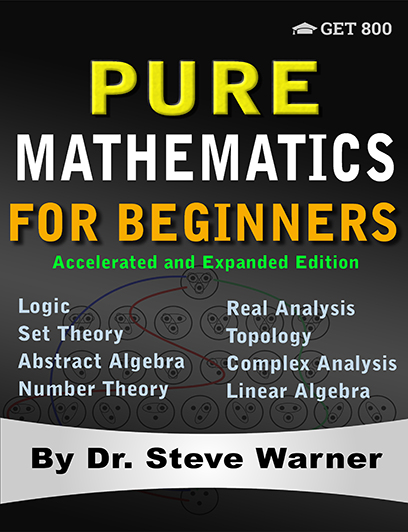

Pure Mathematics for Beginners –
Accelerated and Expanded Edition
Just 19.99 on Amazon
Hi everyone! Pure Mathematics for Beginners – Accelerated and Expanded Edition is now available in paperback from Amazon. Similar to its predecessor, this book was written to provide a rigorous introduction to Logic, Set Theory, Abstract Algebra, Number Theory, Real Analysis, Topology, Complex Analysis, and Linear Algebra. The book consists of 16 lessons. Explanations to all the problems in the book are included as a downloadable PDF file.
So, what do I mean by “accelerated and expanded” edition?
By “accelerated” I mean that the book covers most of the material from the standard edition within the first half of the book. For example, the first lesson on set theory now covers relations, functions and equinumerosity (in addition to all the basics). However, nothing is left out. Everything from the original edition is included. In fact, more exposition has been added to the original content, as well as more examples and additional clarifying remarks.
By “expanded,” I mean that a huge amount of additional content has been added to the book. In fact, most of the content in Lessons 9 through 16 consists of material that is not covered in the original edition (although some of the content can be found in my other books from this series such as Real Analysis for Beginners and Abstract Algebra for Beginners).
The paperback is now on sale on Amazon for only $19.99. Note that once the sale ends (in about 24 hours), the price of this book will go up to $64.99.
The promotion is now over. Thanks to all who participated. The book is available at Amazon here: Pure Mathematics for Beginners – Accelerated and Expanded Edition
You can get the solution guide in paperback here: Pure Mathematics for Beginners – Accelerated and Expanded Edition – Solution Guide (Note that you can download the solution guide as a PDF for free, but many readers prefer to have a physical copy of the solution guide.)
If you have any questions, feel free to contact me at the following email:
Thank you all for your continued support!
A Trick For Free Two Day Shipping
I would like to finish this post with a little trick you can use to get free 2 day shipping on any of the books you decide to purchase without making any additional purchases. If you have never used Amazon Prime you can sign up for a free month using the following link.
Sign Up For Amazon Prime For Free
If you have already had a free trial of Amazon Prime you can simply open up a new Amazon account to get a new free trial. It just takes a few minutes! You will need to use a different email address than the one you usually use.
This next part is very important! After you finish your transaction, go to your Account, select “Manage my prime membership,” and turn off the recurring billing. This way in a month’s time Amazon will not start charging you for the service.
After shutting off the recurring billing you will still continue to receive the benefit of free 2 day shipping for one month. This means that as long as you use this new Amazon account for your purchases you can do all of your shopping on Amazon for the next month without having to worry about placing minimum orders to get free shipping.
Just be aware that certain products from outside sellers do not always qualify for free shipping, so please always check over your bill carefully before you check out.
Well I hope you decide to take advantage of this very special offer, or at the very least I hope you will benefit from my Amazon “free 2 day shipping trick.” Here is the link one more time:
Sign Up For Amazon Prime For Free
If you think your friends might be interested in this special offer, please share it with them on Facebook:

Thank you all for your continued support!
 |
 |
 |
 |
 |
A while back I created a thread that explained how SAT math problems involving remainders can be solved quickly and easily. Quickly take a look at these posts to refresh your memories on what I wrote. Click on these links for part 1 (calculator algorithms) , 2 (cyclical nature of remainders) and 3 (recognizing remainder problems) for the posts in this thread.
I realized that I can share with you certain ‘tricks’ that you can employ to quickly and easily divide numbers without using long division or a calculator. Some of these tricks will actually take less time than typing the numbers into your calculator. With practice these tricks can become second nature to you which of course means that you can save precious time on the day of the SAT.
Some of these tricks will be obvious to you, but that is only because you have practiced the trick for that particular type of number so often that it has already become second nature to you.
Here are some easy tricks that you may already know:
- An integer is divisible by 2 precisely when the last digit is 0, 2, 4, 6 or 8.
For example, 326 is divisible by 2, whereas 327 is not.
- An integer is divisible by 3 precisely when the sum of its digits is divisible by 3.
For example 477 is divisible by 3 because 4 + 7 + 7 = 18, and 18 is divisible by 3.
What about 5215? Well, 5 + 2 + 1 + 5 = 13. Since 13 is not divisible by 3, neither is 5215
- An integer is divisible by 4 precisely when the number formed by taking just the last two digits of the integer is divisible by 4.
For example, 2,136,416 is divisible by 4 simply because 16 is divisible by 4.
What about 532,211. Well 11 is not divisible by 4. So neither is 532,211.
- An integer is divisible by 5 precisely when the last digit is 0 or 5.
So 6,235 is divisible by 5, but 2,112,321 is not divisible by 5.
- An integer is divisible by 6 if it is divisible by 2 and by 3.
Let’s check if 2,132,478 is divisible by 6. Well this number ends in 8, so it is divisible by 2. Also, 2 + 1 + 3 + 2 + 4 + 7 + 8 = 27. Since 27 is divisible by 3, so is 2,132,478. Since this number is divisible by both 2 and 3, it is divisible by 6.
- An integer is divisible by 9 precisely when the sum of its digits is divisible by 9.
For example, 477 is divisible by 9 because 4 + 7 + 7 = 18, and 18 is divisible by 9.
What about 5214? Well, 5 + 2 + 1 + 4 = 12. Since 12 is not divisible by 9, neither is 5214. (Note however, that 5214 is divisible by 3).
- An integer is divisible by 10 if it ends in a 0.
So 5960 is divisible by 10, and 7655 is not.
Here are a few more – these are advanced divisibility tricks:
Please take note that these last few tricks are not standard at all, and almost nobody knows them. I am including them more for fun, and because it makes the post more complete (otherwise the only numbers “left out” are 7 and 8). But most students can skip them.
- Here is a nice little algorithm for testing if an integer is divisible by 7: Double the last digit of the integer and subtract this value from the original integer with the last digit removed. If this new number is divisible by 7, so is the original number. Otherwise it is not.
Let’s check if 5362 is divisible by 7:
536 – 2(2) = 532
53 – 2(2) = 49
Since 49 is divisible by 7, so is 532. Since 532 is divisible by 7, so is 5362.
- An integer is divisible by 8 precisely when the number formed by taking just the last three digits of the integer is divisible by 8.
For example, let’s check if 2,136,416 is divisible by 8. Well when we divide 416 by 8 we get 54. So 416 is divisible by 8, and therefore so is 2,136,416.
- Is there a way to test for divisibility by 11? Yes there is. Add up every other digit beginning with the second digit from the left, and then subtract the remaining digits. If this new number is divisible by 11, so is the original number. Otherwise it is not.
Let’s check if 28,765 is divisible by 11. Well (8 + 6) – (2 + 7 + 5) = 0. Since 0 is divisible by 11, so is 28,765.
As mentioned, I do not recommend worrying about these last few for the SAT. I just included them for those of you that might be interested in learning some more advanced tricks. Note that there are many, many more advanced divisibility tricks out there. If I were to include them all, this post would be ten pages long, so I needed to stop here. But feel free to post your favorites in the comments and we can discuss them. In any case, with practice you will be using divisibility tricks without even realizing it!
Here is a video containing this information:
You can practice using problems found in my books.
If you have any questions or comments let me know… If you found the post helpful, why not use the share button below to let your friends know of this post too? A share would be much appreciated.
Speak next week!